
How to Become a Key Person of Influence in New Markets
Do not arrive in a new country asking for business. Arrive bringing value.
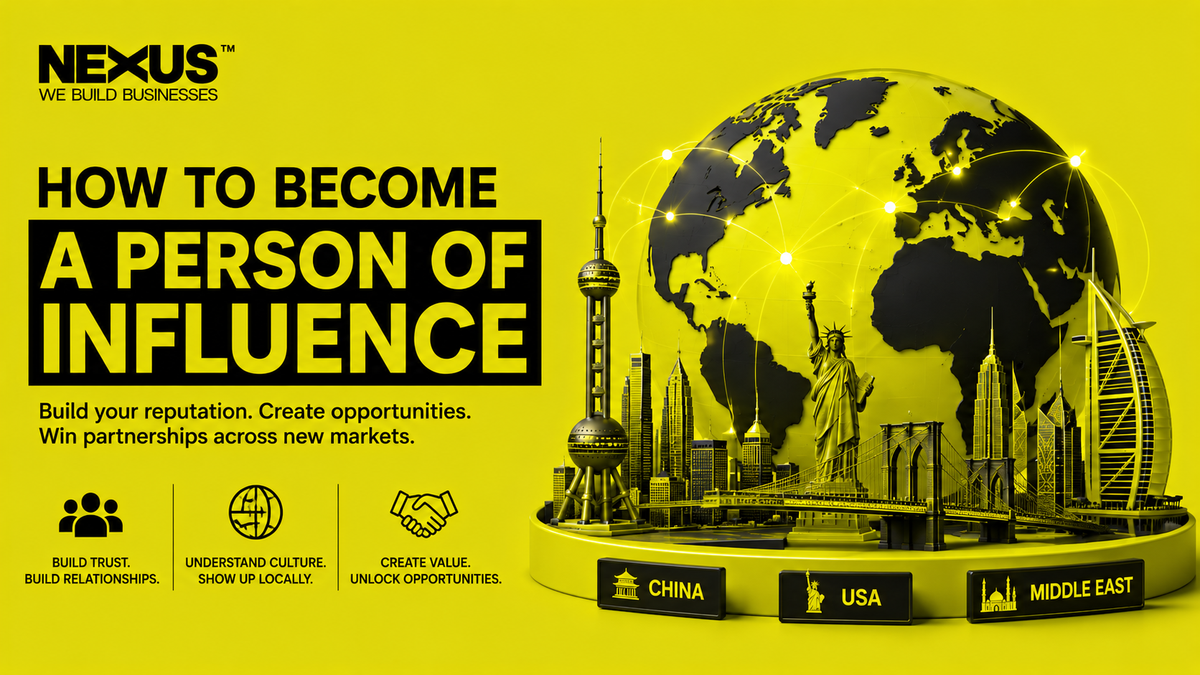
How founders can build reputation, relationships and commercial opportunities across China, the US and the Middle East
There is a big difference between entering a new market and becoming known in one.
You can open an office in Dubai.
Register a company in Shanghai.
Hire a salesperson in New York.
None of those things make you influential.
Influence comes when the right people in that market know who you are, understand what you stand for, trust your expertise and think of you when an opportunity appears.
That is when international expansion starts to become really interesting.
Because once you become known, doors start opening.
Introductions happen.
Partnerships appear.
People invite you into conversations you would never have found through cold outreach.
The question for founders is therefore not simply:
"How do I sell into China, America or the Middle East?"
It is:
"How do I become someone that people in those markets want to know?"
Stop thinking like an exporter
One of the biggest mistakes founders make when expanding internationally is behaving like an exporter.
They translate the website.
Run some advertising.
Send a few LinkedIn messages.
Attend one conference.
Then wonder why nothing happens.
The strongest international founders think differently.
They become part of the ecosystem.
They meet people.
They contribute ideas.
They speak at events.
They publish insights.
They build relationships with investors, founders, government organisations, universities, media and industry bodies.
They find local partners on the ground.
They become visible before they need anything.
That last point is incredibly important.
Do not arrive in a new country asking for business. Arrive bringing value.
Build a reputation around something specific
Influence starts with positioning.
If someone introduces you by saying:
"He's involved in lots of things"
you have a problem.
If they say:
"She's one of the people to know when it comes to AI adoption in financial services"
you have something much more valuable.
You have a reputation.
Pick a territory.
It might be AI.
Climate technology.
Fintech.
Healthcare.
Luxury.
Education.
Cross-border investment.
Advanced manufacturing.
Then become relentlessly useful around that subject.
Write about it.
Speak about it.
Interview people about it.
Publish research.
Bring people together.
Comment intelligently on developments.
Create your own frameworks.
The goal is not to become famous.
The goal is to become recognisable.
Your social strategy needs to change by market
One of the biggest mistakes in international personal branding is assuming that the same social strategy works everywhere.
It doesn't.
🇨🇳 China
LinkedIn is not the centre of the Chinese professional ecosystem in the way it is in the West.
For founders targeting mainland China, you need to understand platforms such as WeChat, Douyin, Xiaohongshu and Weibo, with each serving different purposes. WeChat is particularly important for professional relationships and ongoing communication, while Douyin and Xiaohongshu can be powerful for visibility and discovery.
This changes the content strategy.
Don't simply translate your LinkedIn posts.
Create content that makes sense for Chinese audiences.
Use Chinese language where appropriate.
Work with local creators and KOLs.
Build relationships through WeChat.
And most importantly, have someone on the ground who understands how the ecosystem actually works.
China's business environment still places significant value on guanxi, meaning trusted relationships. Official guidance specifically highlights face-to-face meetings, introductions through trusted intermediaries and continuous communication as important to building successful partnerships.
In other words:
Your network is not a side project in China. Your network is part of your market-entry strategy.
Book a call with the NEXUS team to see how we can best support your potential international expansion
🇺🇸 The US
America is different.
The opportunity is enormous, but the market is also brutally competitive.
You need a sharper proposition.
A stronger point of view.
More proof.
And considerably more visibility.
LinkedIn should be a core platform for B2B founders, alongside YouTube, podcasts, industry communities and relevant parts of X and Instagram.
The American market tends to reward clarity.
Tell people what you do.
Explain why it matters.
Show the evidence.
Make the commercial opportunity obvious.
Don't spend six months building a relationship before revealing why you are there.
Be personable, but be commercially clear.
The US is also an excellent market for founder-led content.
A founder who can consistently explain an industry, challenge conventional thinking and demonstrate expertise can build authority remarkably quickly.
Your objective should be to become:
"The British founder who really understands X."
Or:
"The person to speak to about Y."
That is far more powerful than simply saying you have expanded into America.
🇦🇪🇸🇦 The Middle East
The Middle East needs its own strategy too.
And even within the region, Dubai, Abu Dhabi and Riyadh should not simply be treated as interchangeable markets.
The UAE is highly international and acts as a major regional business hub. Personal relationships, integrity, face-to-face contact and frequent market visits remain important. Trade events can be particularly valuable for building those relationships.
Saudi Arabia is similarly relationship-driven, with trust and familiarity often established before serious business discussions begin. Meetings may take longer and relationship building can be a significant part of the process.
This means your Middle East strategy should include:
LinkedIn for authority.
Instagram for visibility and personal brand.
WhatsApp for relationships and ongoing conversations.
X for public commentary and regional conversations.
And, critically, physical presence.
If you want to become influential in the Gulf, don't expect to build the entire relationship from a laptop in London.
Get on a plane.
Attend the events.
Meet people.
Accept the coffee.
Have the conversation.
Then follow up.
Learn the cultural rules
Being influential internationally does not mean pretending to be someone else.
It means understanding the environment you are operating in.
Small details matter.
In China, business cards are traditionally presented and received with both hands, and taking time to look at the card is part of the etiquette. WeChat has also become increasingly common for exchanging contact details among younger business professionals.
In the Middle East, relationship building and hospitality are important. In the UAE, visitors should be punctual even though meetings themselves may run longer than expected, and accepting tea or coffee is generally part of the hospitality culture.
These details may sound small.
They aren't.
They demonstrate that you have made an effort.
And effort creates credibility.
Book a call with the NEXUS team to see how we can best support your potential international expansion
Become useful to powerful people
Here's where influence becomes much more interesting.
Don't just network with people who can buy from you.
Build relationships with people who shape the ecosystem.
Investors.
Government representatives.
University leaders.
Accelerators.
Journalists.
Industry association executives.
Corporate innovation teams.
Founders.
Family offices.
Event organisers.
Trade bodies.
The goal isn't to ask them for favours.
It is to become useful to them.
Make introductions.
Share intelligence.
Invite them onto your podcast.
Include them in research.
Bring them customers.
Introduce them to investors.
Invite them to speak at your events.
The more value you create for important people, the more likely they are to remember you.
And when they remember you, opportunities follow.
Create your own reason for people to meet you
This is one of the most powerful strategies for becoming influential in a new market.
Don't always go looking for events.
Create one.
Host a dinner for ten founders.
Run a roundtable on AI.
Publish a China market report.
Create a UK-US founder breakfast.
Organise a private investor discussion.
Host a webinar with three respected local experts.
Suddenly you aren't asking:
"Can I meet you?"
You are saying:
"I'm bringing together ten interesting people in your industry. Would you like to join us?"
That completely changes the dynamic.
You become a connector.
And connectors become influential.
Borrow other people's audiences
You don't need to build an audience of 100,000 people from scratch.
You need access to the right 100 people.
Find the established voices in your target market.
Podcasters.
Newsletter writers.
Journalists.
Conference organisers.
Industry analysts.
Creators.
Investors.
Founders.
Then create reasons to collaborate.
Offer research.
Bring a useful perspective.
Give them an interesting guest.
Share their work.
Invite them into your community.
Get interviewed.
Speak on their podcast.
Write guest articles.
Appear on panels.
This is how you borrow credibility while building your own.
Make your digital presence look local
When someone hears your name in Shanghai, New York or Riyadh, they are going to search for you.
What do they find?
Your LinkedIn profile should immediately communicate your expertise.
Your website should make your international focus obvious.
Your social profiles should tell the same story.
Your content should demonstrate that you understand the market.
And your profile should contain proof.
Client results.
Partnerships.
Speaking appearances.
Research.
Media coverage.
Case studies.
Events.
The aim is to create a digital footprint that makes someone think:
"This person is already part of our ecosystem."
Not:
"This person is trying to get into our market."
There is a huge difference.
Don't underestimate local credibility
One of the fastest ways to establish authority in a new market is to be associated with people who already have it.
Partner with a respected local organisation.
Collaborate with a university.
Speak at an established conference.
Work with a recognised investor.
Publish research with a local expert.
Build a joint initiative.
These associations transfer credibility.
They also help you understand the market from the inside.
This is particularly important in China, where trusted introductions and personal relationships remain important to business development.
Get physically present
There is a point where digital stops being enough.
Go there.
Walk the streets.
Visit companies.
Attend conferences.
Have dinners.
Meet competitors.
Meet potential customers.
Meet government and industry representatives.
Understand what people actually talk about.
China's official business guidance continues to emphasise face-to-face connections and frequent visits as important to building successful relationships.
The same principle applies in the UAE, where face-to-face contact and local trade events are specifically highlighted as important to establishing business relationships.
Physical presence sends a message:
I'm serious about this market.
Understand that influence compounds
The first month might feel like nothing is happening.
Then someone introduces you to someone else...
The mistake is expecting every activity you do to generate an immediate sale.
Your first objective is visibility.
Then credibility.
Then relationships.
Then opportunities.
Then revenue.
The NEXUS International Influence Playbook
If you were entering China, the US or the Middle East tomorrow, I'd build your strategy around five things.
1. Own a topic
Become known for one valuable area of expertise.
2. Build a local network
Identify 50 people who matter in that ecosystem and start creating genuine relationships.
3. Create local content
Don't simply repost your domestic content. Talk about the issues, opportunities and people shaping the market.
4. Become a connector
Bring interesting people together. Host events. Make introductions. Create opportunities.
5. Show up
Online consistently.
Offline regularly.
And in person whenever the relationship matters.
The Bigger Opportunity
International expansion is often described as a sales challenge.
I think that misses the bigger opportunity.
It is a reputation challenge.
If nobody knows you, every conversation starts from zero.
If the right people know you, trust you and understand what you stand for, the entire market becomes easier to navigate.
That is why becoming a person of influence can be such a powerful international growth strategy.
You are not trying to become a celebrity.
You are trying to become known by the right people for the right thing in the right market.
In China, that might mean becoming a trusted expert within a particular industry ecosystem.
In America, it might mean becoming the founder whose ideas consistently appear in the conversations shaping your sector.
In the Middle East, it might mean becoming the person connecting investors, founders, government, technology and international businesses.
Different markets.
Different cultures.
Different platforms.
Different ways of building trust.
But the underlying principle is the same.
Be useful. Be visible. Build relationships. Create value. Show up consistently.
Do that for long enough and you stop looking like an outsider trying to enter a market.
You become part of the market.
And that is when international growth gets really interesting.
If you're interested in starting, running or scaling your own business, then why not enquire about NEXUS membership here
...and if you're interested in featuring your entrepreneurial journey on the NEXUS Startup Diaries blog, then get in touch and let's share that story with the world!