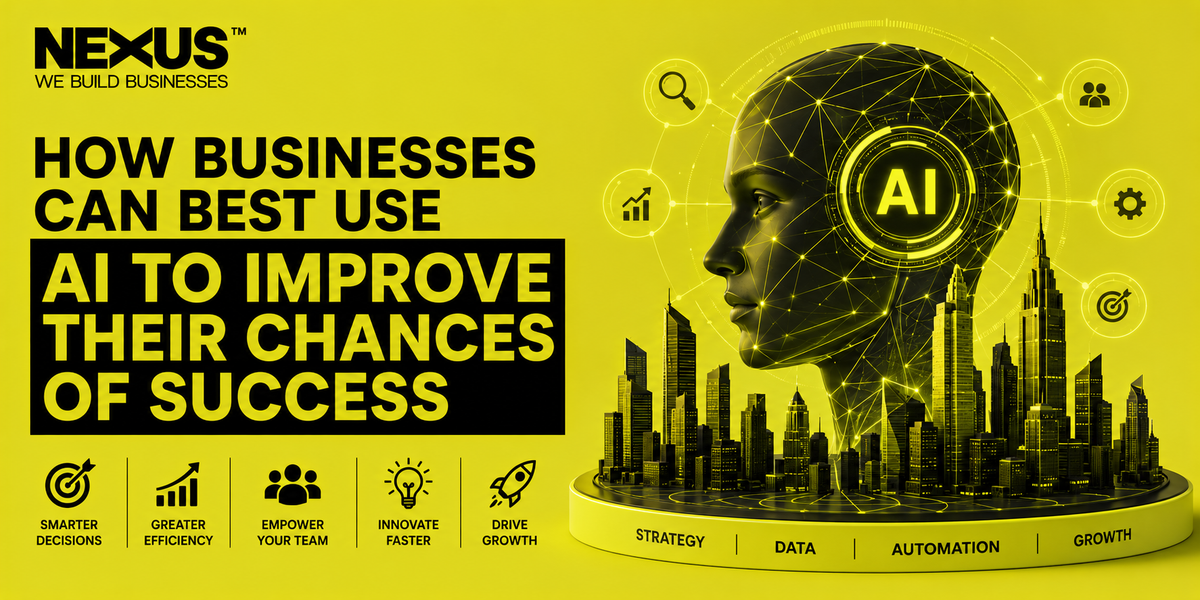
How Businesses Can Best Use AI to Improve Their Chances of Success
The businesses that win with AI will not necessarily be the ones using the most AI. They will be the ones that understand which problems to give it, which tools to use, how to provide the right context and where human judgement still matters most.
AI has moved beyond being a clever tool for generating emails, writing social posts or summarising meetings.
For businesses, the bigger opportunity is much more interesting.
AI can help you make better decisions, move faster, understand customers more deeply, reduce costs, improve your products and give a small team capabilities that previously required an entire department.
But there is a catch.
Simply having access to AI does not create a competitive advantage.
Your competitors have access to the same models.
The advantage comes from how intelligently you use them.
The businesses that win with AI will not necessarily be the ones using the most AI. They will be the ones that understand which problems to give it, which tools to use, how to provide the right context and where human judgement still matters most.
Stop asking "What can AI do?"
One of the easiest ways to waste time with AI is to start with the technology.
"What can ChatGPT do?"
"What can Gemini do?"
"Should we be using Claude?"
These are interesting questions, but they are not business questions.
Start with:
Where are we currently wasting time?
Where are we making decisions with incomplete information?
Where are customers experiencing friction?
Where could we deliver a better service?
Where are we spending money unnecessarily?
Where could we move faster?
Those questions lead you towards genuine commercial opportunities.
AI should not become another piece of software your team has to learn.
It should become an operating layer across the business.
1. Give AI the right job
Not every problem needs an LLM.
And not every LLM is equally good at every task.
One of the biggest mistakes businesses make is treating AI as a single tool.
Think of your AI stack more like a team.
ChatGPT can act as your generalist.
Claude can be excellent for writing, complex documents and nuanced reasoning.
Perplexity can be useful when research and sources matter.
Gemini becomes particularly interesting if your business already operates heavily within Google's ecosystem.
Microsoft Copilot can bring AI directly into Word, Excel, Outlook, Teams and PowerPoint.
Grok can be useful for understanding live conversations and emerging trends.
DeepSeek is worth considering for cost efficient reasoning and technical workloads at scale.
Mistral is particularly interesting for businesses where European infrastructure, control and data considerations matter.
The lesson is simple:
Don't ask which AI is best. Ask which AI is best for this particular job.
2. Stop throwing enormous amounts of information at AI
More information does not automatically produce better answers.
In fact, giving a model a huge amount of irrelevant information can make the result worse.
If you want AI to analyse your sales performance, don't necessarily upload every document your business has ever created.
Give it the information relevant to the question.
If you want it to improve your pricing, give it your current pricing, customer segments, competitors and sales data.
Then ask a specific question.
This is where context quality becomes incredibly important.
A useful prompt isn't necessarily long.
It is relevant.
3. Ask for the smallest useful output
One of the simplest ways to improve both efficiency and cost is to stop asking AI for things you don't need.
If you need five ideas, ask for five.
If you need a decision, ask for a recommendation and the three factors behind it.
If you need a 100 word social post, don't ask for 1,500 words and then spend another ten minutes editing it.
The principle is:
Start small. Expand when necessary.
This makes AI faster, cheaper and easier to work with.
4. Build reusable business context
This is where businesses can move from casually using AI to actually integrating it.
Your company has information that doesn't change every day.
Your brand positioning.
Customer profiles.
Tone of voice.
Pricing.
Product information.
Sales methodology.
Company strategy.
Frequently asked questions.
Competitive positioning.
Instead of repeatedly explaining these things to AI, create reusable instructions, knowledge bases or connected systems.
Now your AI starts every task with an understanding of the business.
That is significantly more powerful than repeatedly typing:
"Here's what my company does..."
5. Turn your knowledge base into an AI asset
Think about how much knowledge already exists inside your company.
Sales calls.
Customer emails.
Support tickets.
Product documentation.
Research.
Meeting notes.
Market reports.
Internal processes.
FAQs.
Much of that information is currently sitting dormant.
AI can help turn it into something searchable and useful.
A salesperson could ask:
"What are the three objections we hear most often from enterprise customers?"
A product manager could ask:
"What feature requests have appeared most frequently over the past six months?"
A founder could ask:
"What are the biggest recurring complaints from customers?"
Instead of searching through hundreds of documents, the business can query its own institutional knowledge.
That can become a genuine competitive advantage.
6. Use AI for decisions, not just tasks
Most businesses initially use AI to save time.
That's useful.
But the bigger opportunity is improving decision quality.
Ask AI to analyse a market.
Challenge your assumptions.
Identify risks.
Compare strategic options.
Stress test your pricing.
Role play a difficult negotiation.
Analyse customer feedback.
Model different scenarios.
Then ask:
"What am I missing?"
This is particularly powerful for founders because one of the biggest constraints on growth is often not execution.
It is the quality and speed of decision making.
AI can act as a tireless second opinion.
But it should remain a second opinion.
The final judgement belongs to the people accountable for the outcome.
7. Use AI to make your best people more productive
AI shouldn't simply be about replacing tasks.
It can increase the capability of your existing team.
A salesperson can research prospects faster.
A marketer can test more creative concepts.
A customer support team can identify patterns across thousands of conversations.
A product team can analyse feedback faster.
A founder can explore strategic scenarios before making a decision.
The objective should be:
How can we give every person in the business an AI co-pilot that makes them better at their job?
That is a much more powerful question than:
"Which jobs can we automate?"
8. Don't waste expensive models on simple tasks
Not every task needs your most capable model.
Classification.
Data extraction.
Simple rewriting.
Summaries.
Categorisation.
Basic customer queries.
These can often be handled by faster, cheaper models.
Reserve more capable reasoning models for genuinely complex work.
This matters enormously as AI adoption scales.
If your business processes 100 tasks a month, the difference might be irrelevant.
If you're processing 100,000 or 10 million, model economics become a business strategy.
9. Measure AI like any other investment
AI projects can become incredibly vague.
"We're using AI more."
"Our team is experimenting with it."
"We've built a chatbot."
None of these necessarily mean anything commercially.
Instead, measure outcomes.
How much time did it save?
Did conversion improve?
Did customer satisfaction increase?
Did support costs fall?
Did employees complete more work?
Did the quality of decisions improve?
Did revenue increase?
What did each successful AI interaction cost?
Once you measure AI against business outcomes, it becomes much easier to know what deserves more investment.
10. Build an AI operating system, not a collection of experiments
This is perhaps the biggest opportunity for founders.
Don't have 20 people using 20 different AI tools in completely different ways.
Create some basic company-wide principles.
Which models should be used for which tasks?
What information can employees put into AI?
What information is confidential?
Which workflows should be automated?
Where is human approval required?
How should prompts be structured?
How should outputs be checked?
What should be measured?
This creates consistency.
It also stops AI becoming a collection of disconnected experiments.
The Founder AI Toolkit
A simple way to think about the current landscape is:
🧠 ChatGPT: General business thinking and execution
✍️ Claude: Writing and complex reasoning
🔎 Perplexity: Research and evidence
📊 Gemini: Google Workspace and data
💼 Copilot: Microsoft workplace productivity
⚡ Grok: Live trends and conversations
💰 DeepSeek: Cost efficient technical and reasoning workloads
🇪🇺 Mistral: European infrastructure and control
You don't need all eight.
You need to understand which tools solve your particular problems best.
The Real Competitive Advantage
There is a temptation to think that AI will create a new generation of businesses simply because they use the technology.
It won't.
The technology is increasingly accessible to everyone.
Your competitor can use the same model.
They can generate similar images.
They can write similar emails.
They can analyse similar information.
So where does the advantage come from?
It comes from how the business applies AI to its unique knowledge, customers, data, processes and decisions.
Your competitors don't have your customer relationships.
They don't have your history.
They don't have your internal knowledge.
They don't have your brand.
They don't have your people.
They don't have your understanding of your particular market.
That is where AI becomes powerful.
Don't let AI make your business less human
There is one final principle founders should keep in mind.
The more AI generated content enters the world, the more valuable genuine human judgement becomes.
Your customers don't necessarily want to interact with an AI version of your company at every stage.
They want faster service.
Better answers.
More personalised experiences.
But they also want trust.
Empathy.
Creativity.
Judgement.
Accountability.
The goal isn't to remove humans from the business.
It is to remove unnecessary work from humans so they can spend more time doing the things humans are uniquely good at.
That is the opportunity.
🚀 The NEXUS Takeaway
The businesses that get the most from AI won't be the ones asking:
"How can we use AI?"
They'll be asking:
"How could this business operate differently if AI was built into everything we do?"
Start with the problems.
Choose the right models.
Give them the right context.
Use fewer tokens intelligently.
Automate the repetitive.
Augment the talented.
Challenge your decisions.
Measure the results.
And keep humans firmly in the loop where judgement matters.
AI is not the strategy.
AI is the capability that can make a great strategy move faster.
The founders who understand that distinction will have a serious advantage over those who simply add another chatbot to their website.
If you're interested in starting, running or scaling your own business, then why not enquire about NEXUS membership here
...and if you're interested in featuring your entrepreneurial journey on the NEXUS Startup Diaries blog, then get in touch and let's share that story with the world!