NEXUS Masterclass: How To Build A Winning Community in 2026
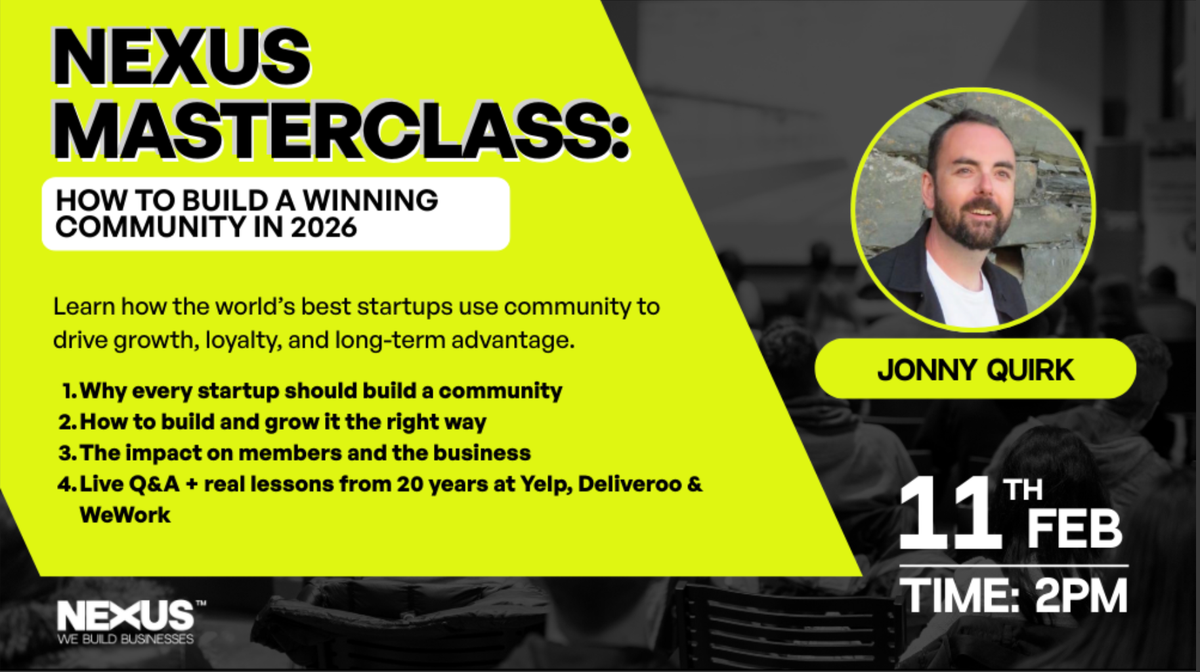
For our February 2026 NEXUS Masterclass, Jonny Quirk laid out a practical, founder friendly way to build a community that delivers deep impact for your business.
Most founders say they want a community.
What they usually mean is: “I want customers who stick around, bring their friends, and help me build something people actually want.”
That is the real game.
For our February 2026 NEXUS Masterclass, Jonny Quirk (Head of Community at NEXUS and Founder of Community Rocket) laid out a practical, founder friendly way to build a community that does more than look busy.
Because the goal is not to host a few events and call it done. The goal is to build a growth engine that compounds over time...
As Jonny laid out in his opening address...if you only remember three things from the NEXUS session, make them these:
- Community extends LTV because relationships keep people around.
- Community lowers CAC because word of mouth beats paid ads.
- Community de risks your business because it becomes a moat competitors cannot easily copy.
Now let’s turn that into something you can actually use today!
The community misconception that quietly kills momentum
A lot of communities fail for one boring reason: they start as a broadcast channel.
The founder posts.
People watch.
Nothing happens.
Everyone slowly drifts away.
But Jonny’s underlying message was the opposite:
A community is not content. It is connection.
Your job is to create repeated moments where members feel seen, helped, and useful. If you do that consistently, the growth benefits show up naturally.
Why founders should care in 2026
Because the old playbook is getting more expensive and less reliable.
Ads are crowded.
Attention is fragmented.
AI makes it easier for competitors to copy features quickly.
Community is different. A good community builds trust, identity, and belonging. Those things are hard to clone.
That is why building a community should be treated like a strategic advantage, not a marketing add on.
Start with Jonny's “First 50” rule
If you’re early stage, ignore the fantasy of thousands of members.
Jonny’s advice is simple: get your first 50 right.
Not 50 random sign ups. 50 people who genuinely care and feel close to you and your product or service.
Why 50?
Because those 50 become your culture. They set the tone. They create the early “this is what we do here” energy. And when you nurture them properly, they naturally bring more people in.
How to find your First 50
- Start with people you already have access to: customers, waitlist, newsletter, personal network.
- Invite, do not just “announce”.
- Make it feel personal, not promotional.
- Give them a reason to raise their hand and join.
How to nurture them
Jonny’s strongest practical point: founders should speak to members directly early on.
Even if you are busy building product, hiring, fundraising, selling, all of it.
Aim for 4 to 6 member calls per week in the early days. Put a simple Calendly link in your welcome message. Ask what they’re trying to achieve, where they struggle, and what would make your community worth returning to.
Those conversations become your roadmap, your messaging, and your retention strategy.
Build a community flywheel, not a group chat
Jonny also framed community as a flywheel that connects your customer journey to community touchpoints.
Here’s the founder friendly version of how you usually sell...
- Strangers discover you
- Prospects get curious
- Customers buy
- Promoters share
- New strangers arrive
Community speeds up step 4, and makes step 3 stick.
The trick is to build touchpoints that match where someone is in the journey.
- New members need clarity of what to do and a quick win to activate them.
- Active members need constant connection and recognition.
- Long term members need new roles and deeper access so they stay engaged with you once the novelty has worn off.
When you align that properly, community stops being “extra work” and starts becoming infrastructure.
Use the 1-9-90 rule to maximise success...
This is one of those ideas that instantly reduces founder stress.
Most communities and social media platforms follow a pattern:
- 90% lurk and consume
- 9% occasionally contribute
- 1% create, lead, and show up constantly
That’s normal human behaviour. It’s not a failure.
The takeaway from the NEXUS Masterclass is this: if you only have 100 members, you will have very few visible contributors. It can feel quiet.
As the community grows, that top layer grows too. The cake gets bigger, and suddenly you have more people creating energy.
So don’t measure your community by how many people talk every day. Measure it by whether people keep coming back, and whether they feel something when they do.
Pick a community MVP, not a community empire
A mistake founders make is trying to run a full community programme before they’ve earned it.
Jonny’s advice in the NEXUS session: start small and sustainable.
If you are a startup team of 1 to 5 people, you do not need 12 initiatives, a weekly event calendar, and a complex gamification system.
You need a simple community MVP with two goals:
- Help members get value quickly
- Create repeat reasons to return
The simplest community MVP that works
- A low friction platform (WhatsApp can work early)
- A clear onboarding message
- One recurring ritual (monthly AMA is a great start)
- A feedback loop you actually act on
That’s enough to begin.
Choose the right type of community for where your business is at.
Jonny broke this down in a way that maps neatly to founder reality.
If you’re early stage, build this first
An internal customer community
Purpose:
- stronger relationships
- faster feedback
- better retention
- product market fit support
If you only build one community layer, make it this one.
Then add this when you have momentum
A brand advocacy layer
Purpose:
- mobilise enthusiastic customers
- create word of mouth
- build trust and social proof
This is where referral energy starts to show up naturally.
Everything else, knowledge sharing communities, innovation challenges, local impact programmes etc, can come later once you have the basics working.
Onboarding is the moment most communities lose people
Founders underestimate how quickly people bounce when they don’t know what to do.
Jonny’s NEXUS advice: make first impressions count.
When someone joins, they should immediately see:
- Why this community exists
- Who it’s for
- What to do next to get started
A simple onboarding checklist
- Create a welcome message that feels human
- One clear action (introduce yourself, answer one prompt)
- One quick win (resource, template, tip, or connection)
- A pointer to the next moment (next AMA, next event, next post)
If people join and land in blank space, they won’t return.
Build narrative and rhythm so the community stays alive
A winning community has a heartbeat.
Here are a few top tips from Jonny that keep communities from going stale:
1. Monthly AMA, even if you are not fundraising
People love behind the scenes access. It builds trust and makes members feel like insiders.
2. Share community moments publicly on socials once a week
“Here’s what happened in the community this week.”
“Here’s what we’re building.”
“Here’s how to join.”
If you don’t talk about your community, it won’t grow.
3. Ask clearly for help
Founders often hint instead of asking.
Be direct:
- “We want feedback on this feature.”
- “We’re hiring for this role.”
- “We need intros to these types of partners.”
- “We want three members to test this.”
Bottom line - if you don’t ask, you don’t get!
Reward and recognition: keep it human, not transactional
A lot of community reward systems feel cringe because they’re overly mechanical.
Jonny’s approach is more human: surprise and delight.
- Send a short personal voice note.
- Write a genuine thank you message.
- Give someone a small spotlight.
- Invite them into an insider group.
- Introduce them to someone useful.
The best recognition doesn’t feel like points. It feels like being seen.
The ultimate test of a real community
Jonny ended with a thought-provoking litmus test:
If your product disappeared tomorrow, would the community still continue?
If the answer is yes, you’ve built something real.
That’s also why community is a moat. Features can be copied. Pricing can be matched. Ads can be outspent.
Belonging to something unique is different.
A simple founder plan for the next 14 days
If you want to move from “we should build a community” to actually doing it, here’s a tight plan based on this session:
Days 1 to 3
- Decide your community MVP platform
- Write a one sentence purpose
- Create a simple join form or landing page
Days 4 to 10
- Invite 20 to 30 people personally
- Start 4 to 6 member calls per week
- Collect the same 3 questions from everyone:
- What do you want help with?
- What would make this community worth coming back to?
- Who else should be here?
Days 11 to 14
- Run your first small ritual:
- a live AMA
- a roundtable
- a member intro thread
- Share what happened publicly
- Ask the group what to do next
That’s it. Simple, human, repeatable.
Our NEXUS view: community is not a vibe, it’s leverage
This NEXUS Masterclass wasn’t about “how to run fun events”.
It was about how founders build resilience into their business model.
Longer retention.
Lower acquisition costs.
Faster learning.
Harder to copy.
If you’re building in 2026, community is one of the best compounding bets you can make, as long as you treat it like relationships, not reach!
Good luck and feel free to reach out if you need some quick answers to your community-building questions!