An Inspiring Week at Manchester Innovation Festival 2026
Enterprise education, commercialisation, investment, AI, advanced materials, social innovation and the practical realities of building a company, all steeped in Manchester's past, present and future.
Last week, the University of Manchester turned its campus and several corners of the city into a five-day working showcase of ideas, research, founders, investors and community projects.
It covered a lot of ground such as: enterprise education, commercialisation, investment, AI, advanced materials, social innovation and the practical realities of building a company - all steeped in Manchester's past, present and future.
Jonny Quirk, Head of Community at NEXUS went along, met some incredible people and came back enthused in what he saw. Let's take a look at some of the highlights .
Monday: The festival opens with a big ambition
The week began with the launch event, Building Impact through Innovation from Manchester for the World. It set out Manchester’s renewed role in UK innovation and policymaking, as well as the University’s aim to become the most innovative university in Europe by 2035.
The big announcement on the day was A Powerhouse of Innovation, a delivery plan for inclusive and impactful innovation. Alongside it came a £10 million Founders Fund to support students, staff and alumni at the pre-seed stage, giving them time and resource to test ideas, build partnerships and explore commercial potential.
Professor Aline Miller, the University’s Associate Vice-President for Innovation, said the fund was about giving people the time to develop their ideas and explore what could be possible.
But the main message was not that every student or researcher should start a company. It was that more people should be given a realistic route from “I have an idea” to “I can test whether this works.”
Our NEXUS takeaway: if you are sitting on an idea, give it a deadline. Spend two weeks speaking to potential customers, mapping the problem and testing the simplest version of the offer. You do not need a company, a logo or a finished product to find out whether the idea deserves more time. Then you can research the local support you need to take it from idea to implementation.
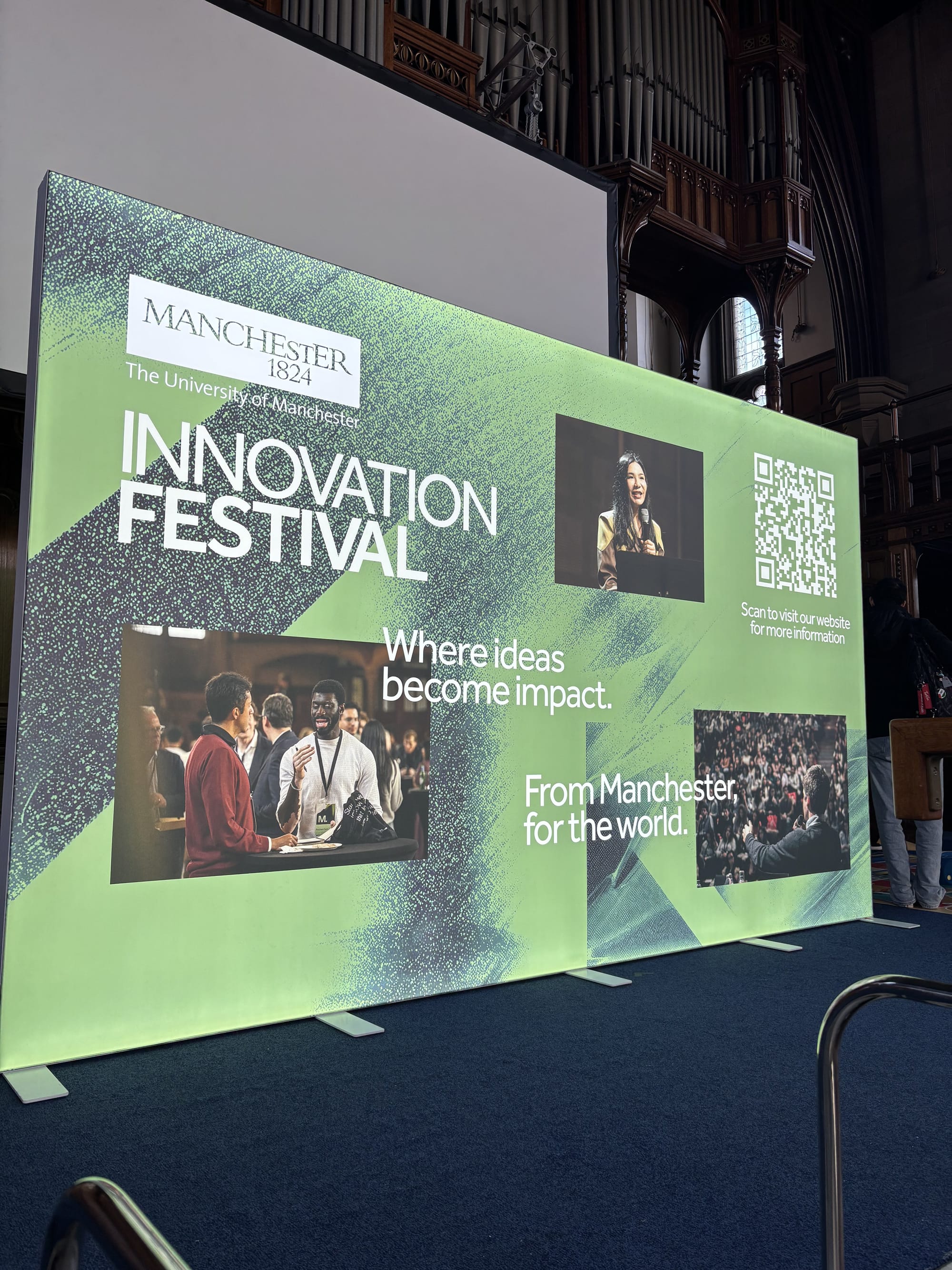
Monday evening: From researcher to founder
Later that day, Conception X and Turing Innovation Catalyst hosted Scientist to Founder at Sister. This session brought together academic founders who had turned research into companies with real-world impact.
It was a useful 180 to the usual startup narrative. Academic founders often have deep technical knowledge but face a different challenge: translating research into something a customer can understand, buy and use.
Our NEXUS takeaway: technical credibility is an advantage, but it is not a business model. If you are coming from research, spend early time with people outside your field and ask them to explain your work back to you. If they can't do this, simplify the language before you simplify the product.
Tuesday: Students learn to turn ideas into businesses
Tuesday belonged to MEC Ideas Unlocked, a full-day entrepreneurship event for University of Manchester students. The idea was simple: get people thinking and acting like entrepreneurs, working with others and sharing ideas.
The Masood Entrepreneurship Centre used the Business Model Canvas to help students move from a vague concept to something more structured. One student, Prem Todeti, captured the problem well: many people have plenty of ideas but do not know how to turn them into a business.
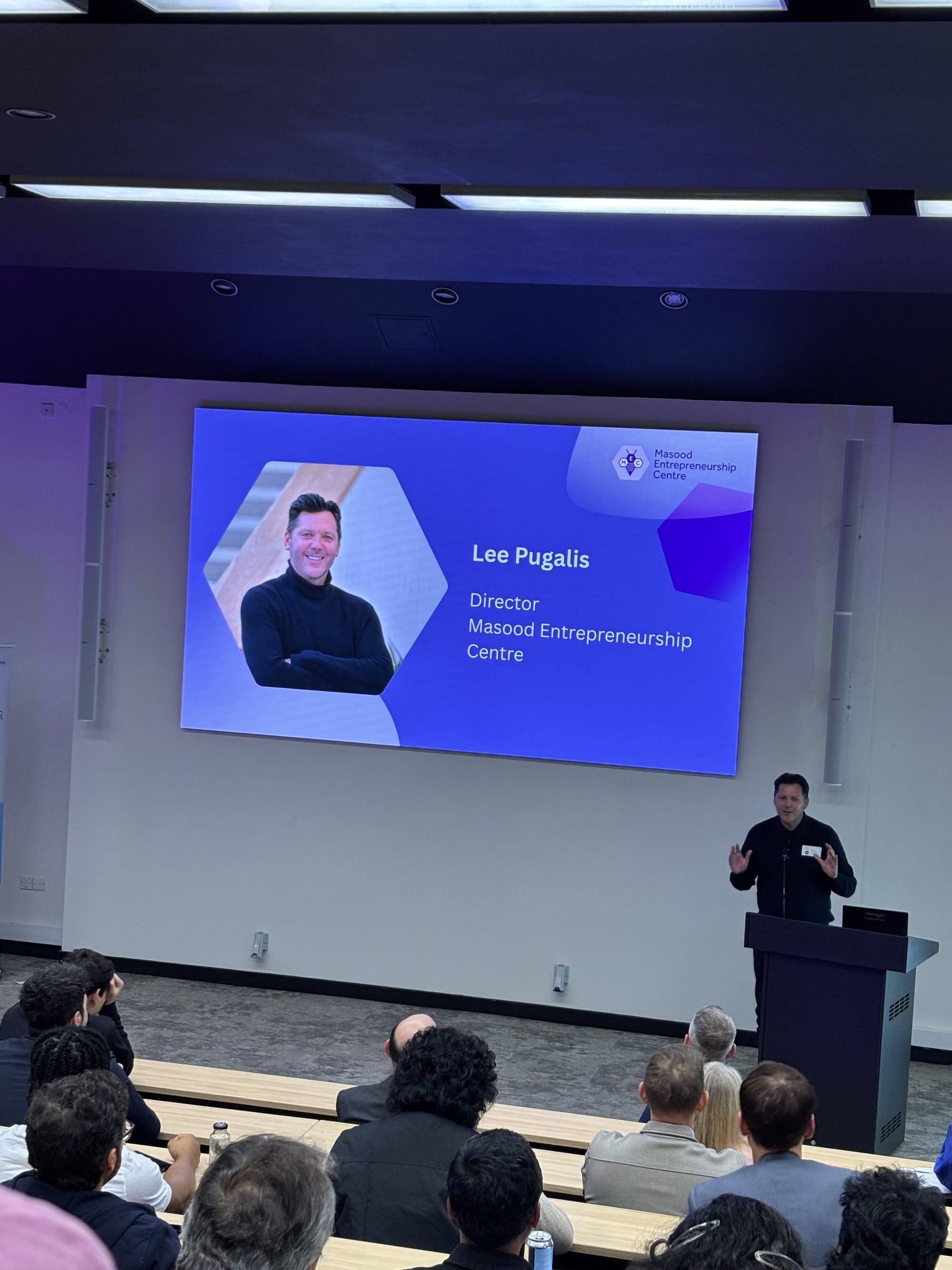
The numbers behind the session were striking. Lee Pugalis, director of the Masood Entrepreneurship Centre, said business formation has almost trebled over five years, with more than 80 businesses created in the past year - that's an inspiring stat and these seeds will only grow year on year.
Tuesday: Founders get practical at Sister
Also on Tuesday was Founder Momentum Day at Sister, a hands-on day for founders covering finance, investment, product development and marketing.
One of the most useful discussions came from Adam Clayton of GM Business Growth Hub, who talked about what investors are really assessing. His main point was that investment is no longer only about the product. Investors are looking at the founding team too - and areas such as transparency, resilience and whether the basic information about the business is organised and accessible.
He also encouraged founders to name their competitors instead of avoiding the question. In his view, competition shows there is money to be made.
Our NEXUS takeaway: build a simple data room before you need one. Put your deck, financial model, cap table, customer pipeline, contracts and key risks in one place. It makes you look prepared, but more importantly, it forces you to understand your own business.
Tuesday: Building northern companies with global reach
The Building Companies That Are Rooted in the North but Global in Mindset session looked at how companies can grow beyond the region without losing their base.
The truth is that for a lot of successful businesses, it takes more than capital. It needs experienced people and mentorship, or what the organisers called “oversize” talent: people who have built and exited companies and want to help earlier-stage teams scale.
The panel made the point that companies go global because their products meet customer needs elsewhere (which we're seeing at NEXUS in terms of us helping businesses expand across borders, especially into China).
Dr Nicola Broughton, chair of Liverpool spinout Extentus Pharma, noted that a company can run sales and commercial activity in the US while keeping research and development in the UK.
Professor Sam Butterworth, founder of Apini Therapeutics, added that Manchester’s scientific reputation can help early-stage companies build credibility.
Our NEXUS takeaway: separate where you build from where you sell. You can be rooted in Manchester and still design your first expansion market around customer demand, distribution and the partners who can open doors.
Wednesday: Research meets the market
Wednesday was all about commercialisation and GTM. Manchester to Market brought together founders, researchers, PhD students, investors and commercialisation experts to look at IP opportunities coming out of the University’s Innovation Factory.
It was a firm but always good reminder that a lot of innovation starts long before it looks like a startup. There is often a research discovery, a prototype, a licence conversation or a technical validation step first. Plus many sleepless nights throughout the whole process.
Our NEXUS takeaway: if you are a researcher with something commercially interesting, do not wait until the science feels completely finished. Start identifying who would use it, what problem it solves and who would need to be involved to take it further.
Wednesday: The wider innovation ecosystem on show
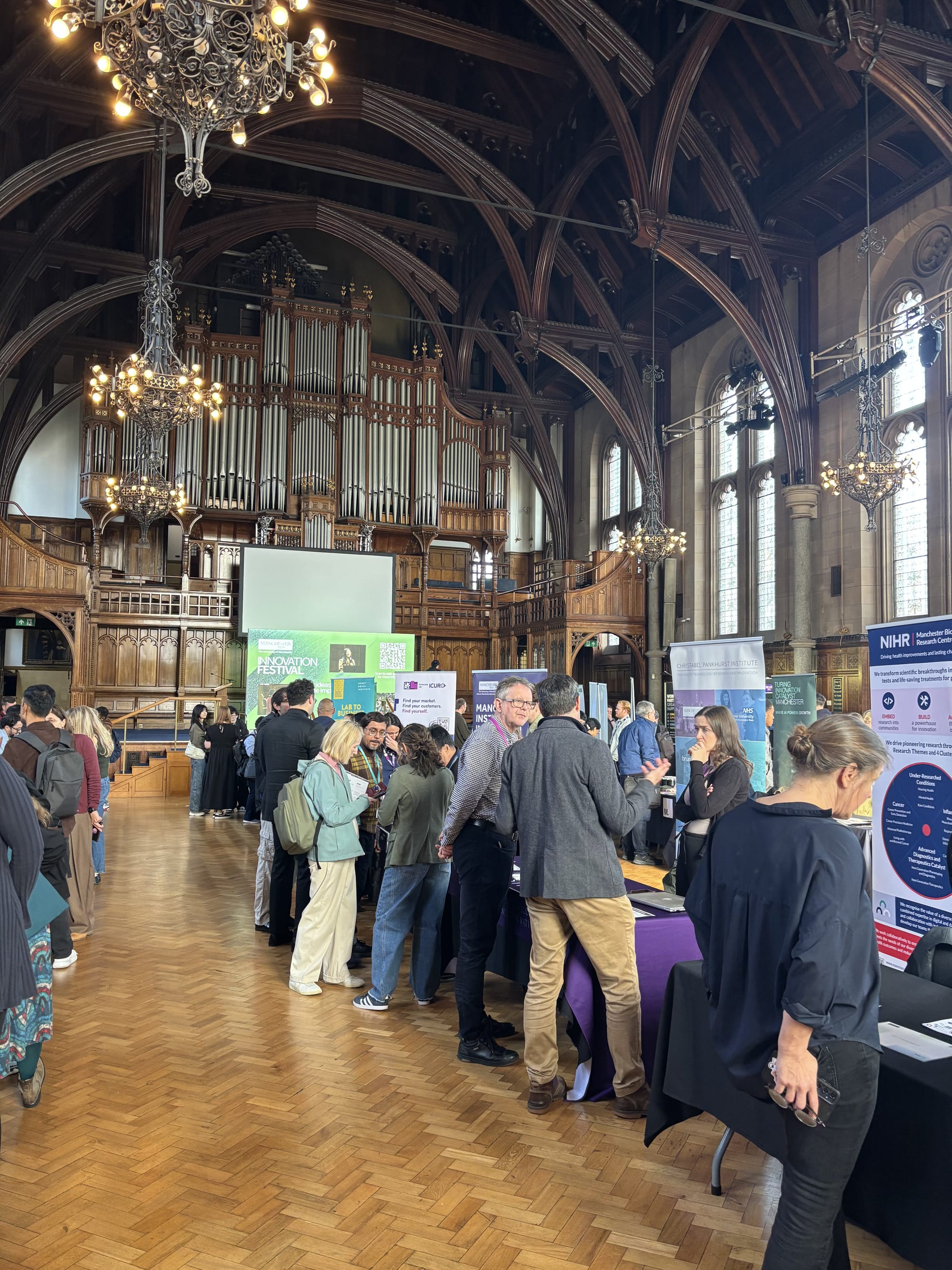
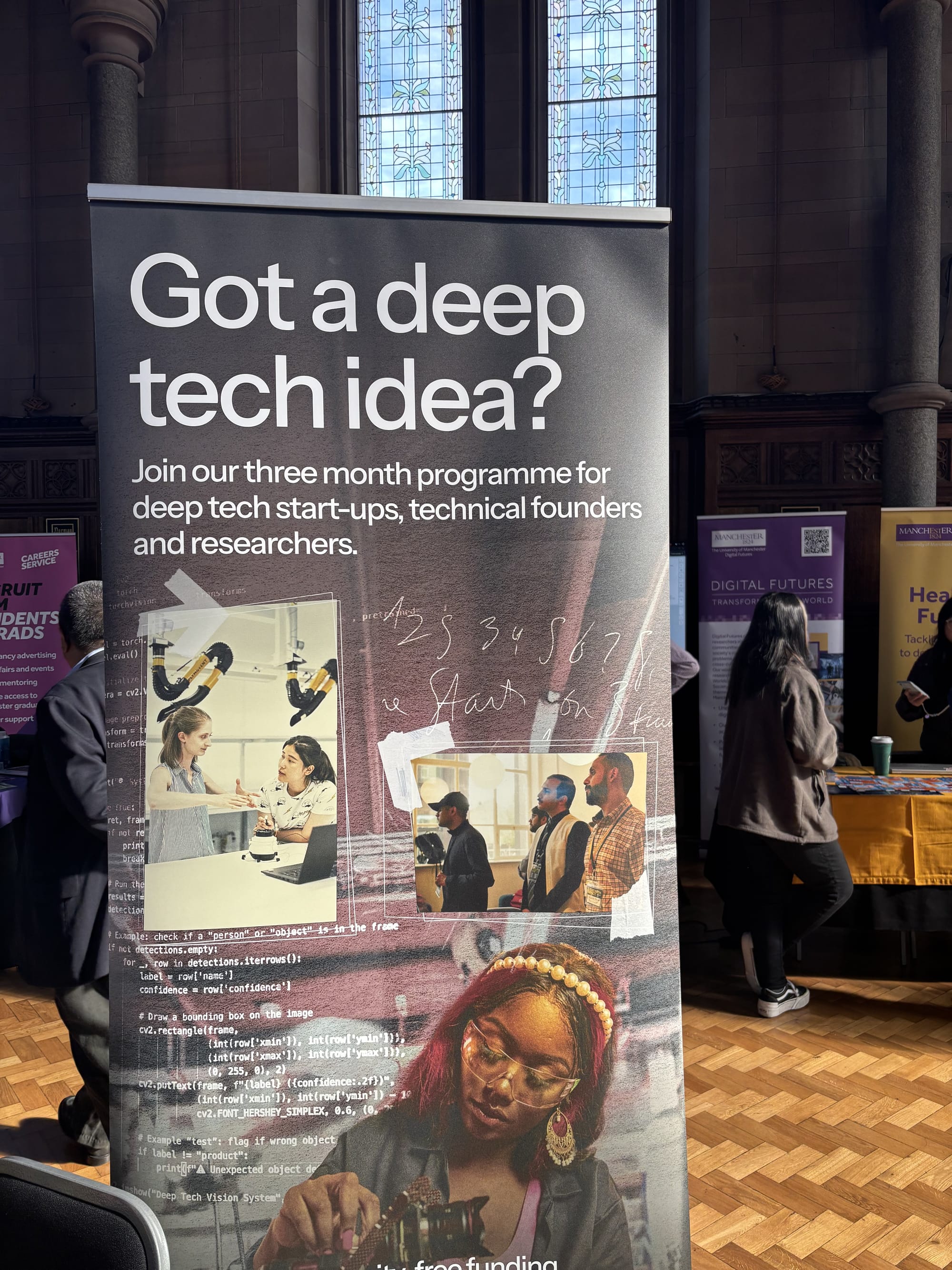
The Powerhouse of Innovation Showcase ran alongside it, bringing together University teams, support services, programmes and strategic partners. It was deliberately interactive, with walk-ins welcome, and gave people a chance to see the range of support available in one place.
For anyone new to the Manchester, North-West of University ecosystem, this was probably one of the most useful parts of the week. It made visible the things that are easy to miss when you are building alone: funding routes, enterprise programmes, research support, partnerships and specialist advice.
Our NEXUS takeaway: make a list of the three things you need most in the next 90 days, whether that is a first customer, technical support, funding or a mentor. Then find the person or programme best placed to help with each one, rather than trying to work everything out alone.
Wednesday evening: Partnership gets its own awards
The first Partnership Excellence Awards closed the day, celebrating collaborations and knowledge exchange that delivered impact beyond the University.
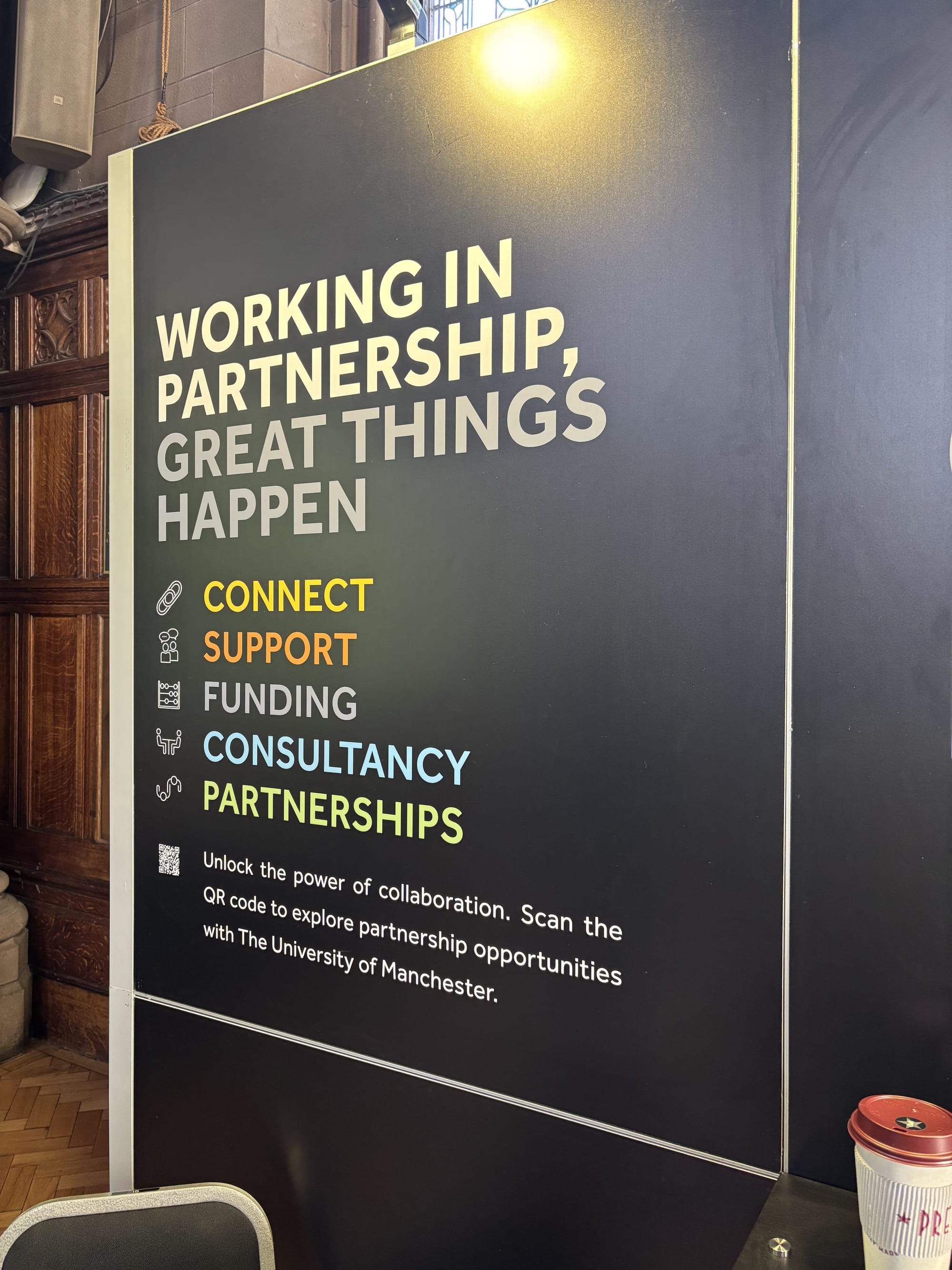
It was a quieter more boutique event, but an important one...because Innovation is often discussed as though it happens inside a single company or lab. When in reality, it usually depends on relationships: between researchers and industry, universities and public bodies, founders and customers.
Our NEXUS takeaway: treat partnerships as part of your growth plan, not a nice extra. Identify the organisations that already have access to your customer, then think about what you can offer them in return.
Thursday: Manchester and Cambridge look beyond their borders
Thursday morning was the Cambridge x Manchester Partnership Innovation Summit at the Whitworth. It brought together founders, researchers, investors, corporates and policymakers to look at how collaboration can speed up innovation-led growth.
The headline idea was “co-opetition”: Manchester and Cambridge competing in some areas while cooperating where it makes sense. Faye Holland, director of the partnership, argued that the UK’s challenge may be less about talent or funding than systems, and set out three aims: to drive economic growth, build for global growth and make sure the benefits reach communities beyond the usual innovation economy.
The practical announcements were significant. An “innovation passport” is planned by the end of the year to give founders and researchers easier access to workspace, accelerator programmes, investors and corporate partners across both cities. A joint investment prospectus is also planned in the near future.
Dr Karim Bahou of Sister really highlighted the imbalance behind the initiative: around 80 per cent of UK venture capital remains in London, Oxford and Cambridge - and this really does need to change!
Our NEXUS takeaway: do not treat your local ecosystem as a boundary. If the right investor, customer or partner is in another city, build the connection. A useful habit is to keep a short list of five people outside your immediate network who could change your business, then find a credible route to each of them.
Thursday: Investors debate capital and regional competitiveness
The Cambridge x Manchester Partnership Investor Summit followed in the afternoon, bringing together investors, institutional ventures and innovation leaders to discuss growth capital, scaling and regional competitiveness.
The conversation kept returning to the same issue: capital is unevenly distributed. Research England’s executive chair, Professor Dame Jessica Corner, argued that the UK is too small to treat its regions as separate ecosystems when investment remains concentrated in already well-resourced places.
Harriet Gordon of No. 10 North put the competitive reality plainly: for investors, the choice is often not Manchester versus Liverpool, but Manchester versus Munich.
Our NEXUS takeaway: if you are raising outside the golden triangle, be clear about why your business is investable, not only why it is promising. Know your market, your numbers, your competition and the specific milestone the investment will help you reach.
Thursday afternoon: Innovation beyond the usual places
Away from the investor rooms, the festival also made space for community-led and social innovation.
Growing Change: Social Innovation from the Ground Up took place at Manchester Museum’s Top Floor, a space focused on widening understanding of where innovation happens and who gets to be an innovator. Later, Inclusive Innovation for People and Planet brought together recipients of Sustainable Futures funding to show how research can become practical action.
There was also an excellent session on Auracast, the audio technology being rolled out at the University and its potential benefits for deaf, hard-of-hearing and neurodivergent communities.
Our NEXUS takeaway: inclusion works best when it is designed in early. Ask who your product excludes, what barriers they face and what would make it easier for them to take part. Then treat those answers as product requirements, not an afterthought.
Thursday evening: Demo Day puts the founders on stage
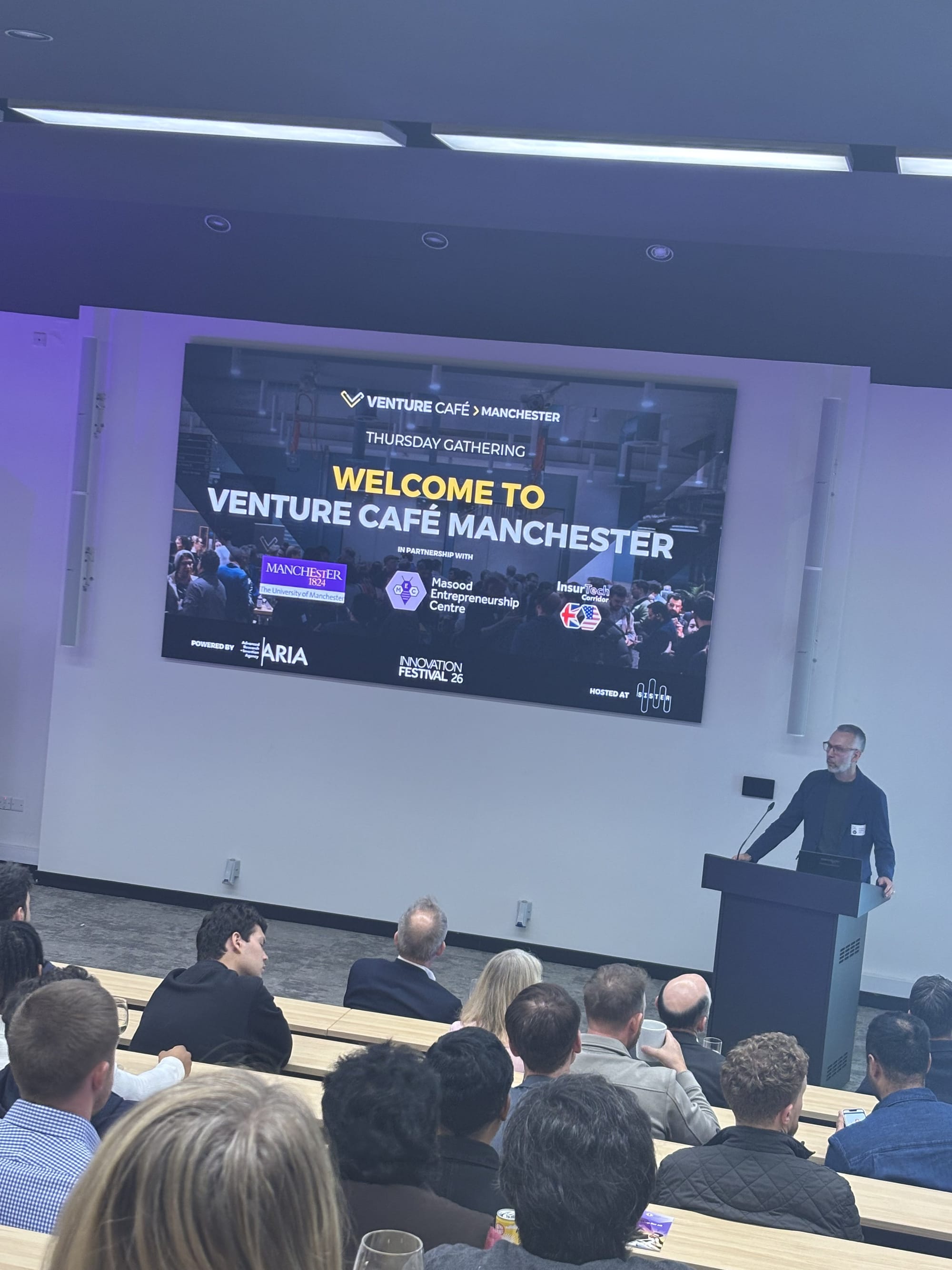
For me, the week reached its natural high point with the Manchester Venture Builder Demo Day - a partnership event between Masood Entrepreneurship Centre and Venture Café Manchester.
It brought together investors, mentors, partners, alumni and the wider innovation community to hear live pitches and meet emerging ventures.
Alongside it, The Founders Playbook put students and aspiring founders in the room with people who had already turned ideas, research and innovation into companies.
The contrast was useful. Earlier in the week, the focus was on structuring ideas and getting support. By Thursday evening, the focus was on standing up, explaining the business clearly and making a case for why it deserved attention.
This was such an inspiring event, with some amazing pitches and well done to every Founder who got up and showcased themselves and their business in front of a packed out audience!
Our NEXUS takeaway: a pitch is not a place to explain everything. Lead with the problem, show the evidence, explain the business model and be specific about what you need next. If someone can repeat your idea back to you afterwards, you have done your job well.
Friday: Advanced materials get a new home
Friday started with a bang at Atom Valley in Rochdale with the completion of the Sustainable Materials and Manufacturing Centre. The facility is due to open in 2027 and will support businesses in advanced materials and manufacturing, offering growth services and access to national innovation networks.
It is a practical piece of infrastructure. For companies working in materials, manufacturing or industrial scale-up, access to the right facilities can be the difference between a promising prototype and something that can be produced at scale.
Our NEXUS takeaway: if your business depends on physical production, do not leave facilities, suppliers and scale-up support until the last minute. Map the path from prototype to production early, including cost, lead times and who you need to work with.
Friday: AI startups pitch for £100,000
The Coller AI Competition brought the festival to a close with University of Manchester AI startups pitching live for a £100,000 equity investment from The Jeremy Coller Foundation. The competition focused on responsible AI solutions to real-world challenges.
The AI Innovation Café also ran that day, giving people the chance to try emerging AI technologies, see AI Pathfinder projects in action and discuss how AI could apply to their own work.
Our NEXUS takeaway: AI is easy to add to a pitch and harder to turn into a product people trust. Start with the problem, be clear about what the AI actually does, and be honest about its limits. The best AI businesses will not win because they use AI. They will win because they solve something specific better than the existing alternative.
We're already looking forward to Manchester Innovation Festival 2027
Manchester Innovation Festival worked because it did not treat innovation as one thing. It showed students learning to structure ideas, researchers exploring commercialisation, founders preparing for investment, investors debating regional capital, communities shaping social innovation and startups pitching for real money.
The common thread throughout was practical: good ideas need structure, evidence, support and people willing to help. Manchester is clearly trying to make those things easier to find for students, staff and the wider population.
For founders, this week was a useful reminder that you do not need to have everything figured out before you start. But you do need to know what problem you are solving, who it is for, what proof you have, and what help you need next.
That is a good place for any startup to begin - and we wish everyone who took part and attended good luck in your future plans.
See you in 2027
If you're interested in starting, running or scaling your own business, then why not enquire about NEXUS membership here
...and if you're interested in featuring your entrepreneurial journey on the NEXUS Startup Diaries blog, then get in touch and let's share that story with the world!